
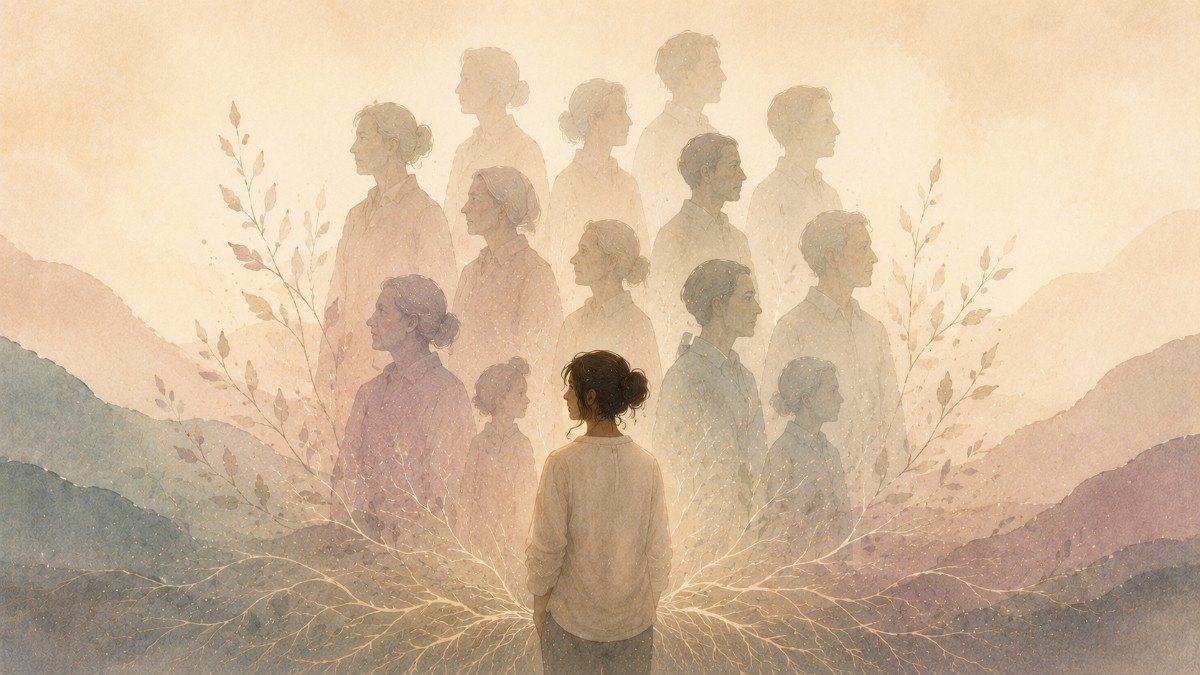
Not Everything You Feel Is Yours: Understanding Inherited Emotional Patterns
Expanding the Frame
Most psychological work focuses on the individual.
Your thoughts, your emotions, your experiences, your history.
This is important, but it is not always complete.
There are times when what you are experiencing does not fully align with your personal story. The intensity may feel disproportionate. The pattern may not make sense based on your own life events.
This is where a broader perspective becomes relevant.
Beyond Personal Experience
Human experience does not develop in isolation.
Each individual exists within a wider system, shaped by family, environment, and generational history. This system carries its own experiences, unresolved events, and emotional patterns.
While these are not always visible, they can influence how individuals feel, respond, and relate.
As a result, not everything that is experienced originates from personal experience alone.
The Nature of Inherited Patterns
Inherited patterns are not passed down in a direct or obvious way.
They do not appear as clear memories or explicit knowledge.
Instead, they may show up as emotional tendencies, relational dynamics, or recurring themes that seem difficult to explain.
This can include persistent anxiety, unexplained guilt, a sense of responsibility that feels excessive, or patterns that repeat across generations.
These experiences can feel deeply personal, while not being entirely rooted in the individual’s own life.
The Concept of Emotional Inheritance
The idea that emotional patterns can be transmitted across generations has been explored in both psychological and biological research.
Work by Gabor Maté highlights how unresolved stress and trauma can shape behaviour, emotional responses, and even physical health.
Additionally, research in epigenetics suggests that the effects of stress can influence how genes are expressed across generations, impacting how individuals respond to their environment.
This does not mean that individuals are defined by what came before them, but it does suggest that they may carry elements of it.
Systemic Dynamics
From a systemic perspective, individuals are part of a larger network that seeks balance.
The work of Bert Hellinger introduced the idea that family systems operate according to certain principles, including belonging, hierarchy, and balance.
When these principles are disrupted, through events such as loss, exclusion, or unresolved trauma, the system may attempt to restore balance in indirect ways.
This can lead to individuals unconsciously carrying emotions, roles, or experiences that do not fully belong to them.
These dynamics are not intentional, but they can be influential.
When the Pattern Does Not Fit
One indication of inherited patterns is when an emotional experience feels out of proportion to the present situation.
The response may be stronger, more persistent, or less explainable than expected.
There may also be patterns that repeat despite conscious effort to change them, or themes that appear across different areas of life without a clear origin.
In these cases, focusing only on personal experience may not fully address the pattern.
The Impact on Identity and Relationships
Inherited patterns can influence how individuals see themselves and how they relate to others.
This may include taking on responsibility that feels excessive, struggling with boundaries, or feeling connected to experiences that are difficult to explain.
In relationships, this can lead to dynamics that feel familiar but are not entirely understood.
Without awareness, these patterns can continue to shape behaviour and experience over time.
Bringing the Pattern into Awareness
The first step in working with inherited patterns is recognising that they may exist.
This does not require assigning blame or analysing the past in detail.
It involves acknowledging that your experience may be influenced by factors beyond your immediate awareness.
As patterns are brought into awareness, they become more visible and less automatic.
This creates the possibility for change.
Differentiation and Integration
Working with inherited patterns is not about rejecting or disconnecting from the past.
It is about differentiation.
This means recognising what belongs to you and what does not, and allowing yourself to relate to each appropriately.
As this process unfolds, there is often a shift in emotional intensity, clarity, and sense of self.
What once felt overwhelming may begin to feel more contained.
Where the Work Begins
If certain emotions, patterns, or experiences feel difficult to explain or consistently repeat, it may be worth considering a broader context.
Not everything that is felt originates within the individual.
Some patterns are carried, rather than created.
Understanding this does not remove responsibility, but it does create space for a different kind of work.
Because the goal is not only to understand yourself.
It is also to understand what you may be holding, and what you no longer need to carry.
If parts of your experience feel difficult to explain or consistently out of proportion, it may be worth exploring what sits beyond your personal history, and what your system may still be carrying.